Data without context
Employee, course, skill and line records sit in separate systems, with different names for the same capability.

The central intelligence layer for workforce capability.
Connect the data. Understand the skills. Capture what the floor knows. Build training from verified evidence.
EXPLORE THE CASEManufacturing runs on disconnected worlds. HR knows who is on shift; learning and competency systems record courses and ratings; production and quality systems record what happened. None of these alone can answer whether a team can do a job to standard, or whether the know-how needed to teach it has ever been documented.
Employee, course, skill and line records sit in separate systems, with different names for the same capability.
Experienced operators know the real fixes, while procedures may be incomplete, missing or out of date.
Generic courses take time to author, and completions say little about demonstrated capability on the line.
Edplay is not another disconnected system. It connects knowledge to skills, skills to people, and each intervention to evidence of what changed.
Connect → understand → detect → capture → build → prove. Each layer turns scattered signals into a more precise, traceable decision.
Edplay connects HR, learning and competency platforms, document repositories and operational systems such as MES, QMS, CMMS and EHS, alongside its own learner evidence. A guided mapping flow previews and validates source fields before activation; ongoing sync checks flag duplicates and missing data.
Edplay maps SOPs, manuals and videos to the skills they support, then resolves assessed proficiency to each person and sub-skill. Equivalent names from different systems can be merged into a canonical skill, while ambiguous matches are held for review. Every claim retains its source evidence and confidence.
Skill gaps show where a person or team falls below the role standard, down to the missing sub-skill. Knowledge gaps distinguish a known need with no source material from an undocumented practice suggested by operational variance. Priority can reflect affected people, criticality and relevant scrap, downtime or incident signals; a named expert can be asked to fill the missing record.
Knowledge already lives all over the plant: in SOPs and manuals, in how-to videos, in records from connected systems, and in the heads of experienced operators. Edplay brings all of it into one place and treats every source the same way. New knowledge is captured straight from the floor: an operator records a 60–90 second explanation or logs a fault, cause and fix, or a team requests missing knowledge from a named expert. Nothing reaches the knowledge base, or the training built on it, until a designated departmental lead has reviewed and approved it.

A departmental lead can request missing knowledge from a named expert, or an operator records a 60–90 second explanation of a recurring fix. No forms, no technical writer, minimal lift for the person who knows.
Edplay drafts the fix as a structured procedure in about 30 seconds, with steps, safety rules and verification points. The expert reviews and corrects the draft; nobody starts from a blank page.
A designated departmental lead reviews and signs off the draft. Nothing enters the knowledge base without human approval, so safety-critical steps and machine tolerances are confirmed by people accountable for them.
The approved micro-skill joins the connected knowledge base, traceable to its source, its expert and its approver. It becomes reusable evidence, not another document on a shared drive.
Training is generated from peers’ own fixes and real floor footage. Operators recognize their line, their machines and their colleagues, which makes the guidance far more likely to be used.
Each capture is a low lift, done in real time as part of the working day. Kept up continuously, those small contributions build a lasting evidence base of what actually happens in the business, before retiring experts walk out the door.
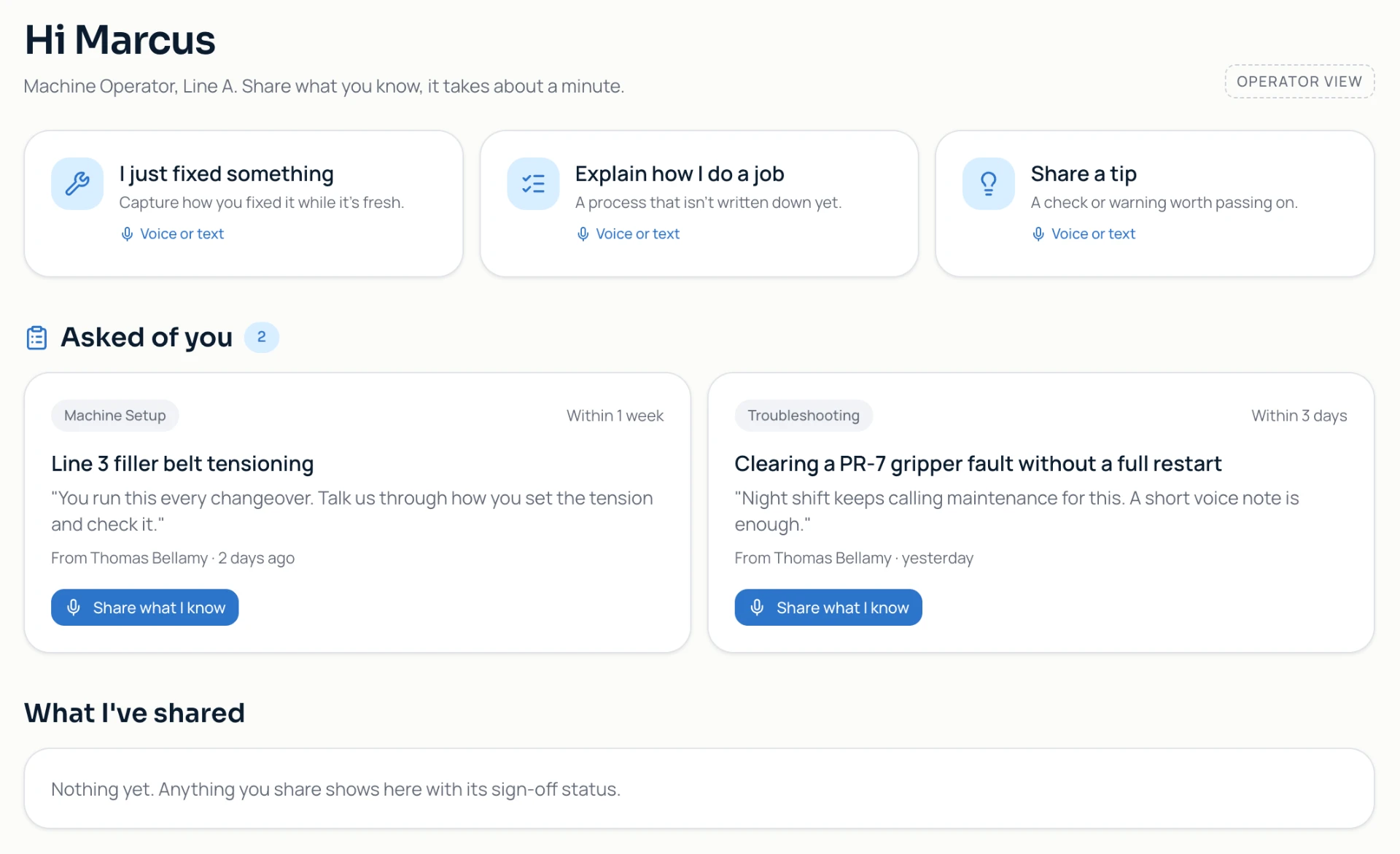
This is what capture looks like for the person who knows. Requests arrive with a deadline and reason, sharing takes about a minute, and each contribution shows its sign-off status.
Add an existing SOP, manual or work instruction to Edplay, rather than recreating what the business already knows.
Edplay identifies the procedures and sub-skills the source can support, while keeping a traceable link to the original file.
A qualified owner checks the extracted knowledge before it becomes available for training.
Upload an existing walkthrough or record a process where the work happens.
The useful moments are organized around the relevant procedure, machine and skill.
A qualified reviewer confirms the material before it supports a lesson or assessment.
Relevant records from operational and people systems enter the shared source layer.
Recurring events and missing source coverage help point to knowledge that needs attention.
Edplay can route a targeted request to the right expert, beginning a new operator contribution.
And the base gets smarter as it grows: every capture sharpens the picture of who knows what, so gaps are easier to spot, requests reach the right expert, and each new course starts from richer evidence than the last.
Every course starts from an instructional blueprint: the audience, target sub-skills, learning outcomes and checks, together with predefined settings for your brand, tone of voice and industry. Edplay's AI content creation then assembles interactive scenarios, video and audio lessons and assessments in minutes, drawing only on the approved knowledge base from Capture, however each item arrived: an operator's own fix, an existing SOP, a how-to video or a record from a connected system. A pre-check avoids reteaching what an operator already knows; a later check and supervisor sign-off test retention.
This is where the gathered knowledge starts teaching. Operator contributions, approved SOPs and knowledge from connected systems come together as a course inside Edplay, built for the specific skill that needs work and delivered on the floor.
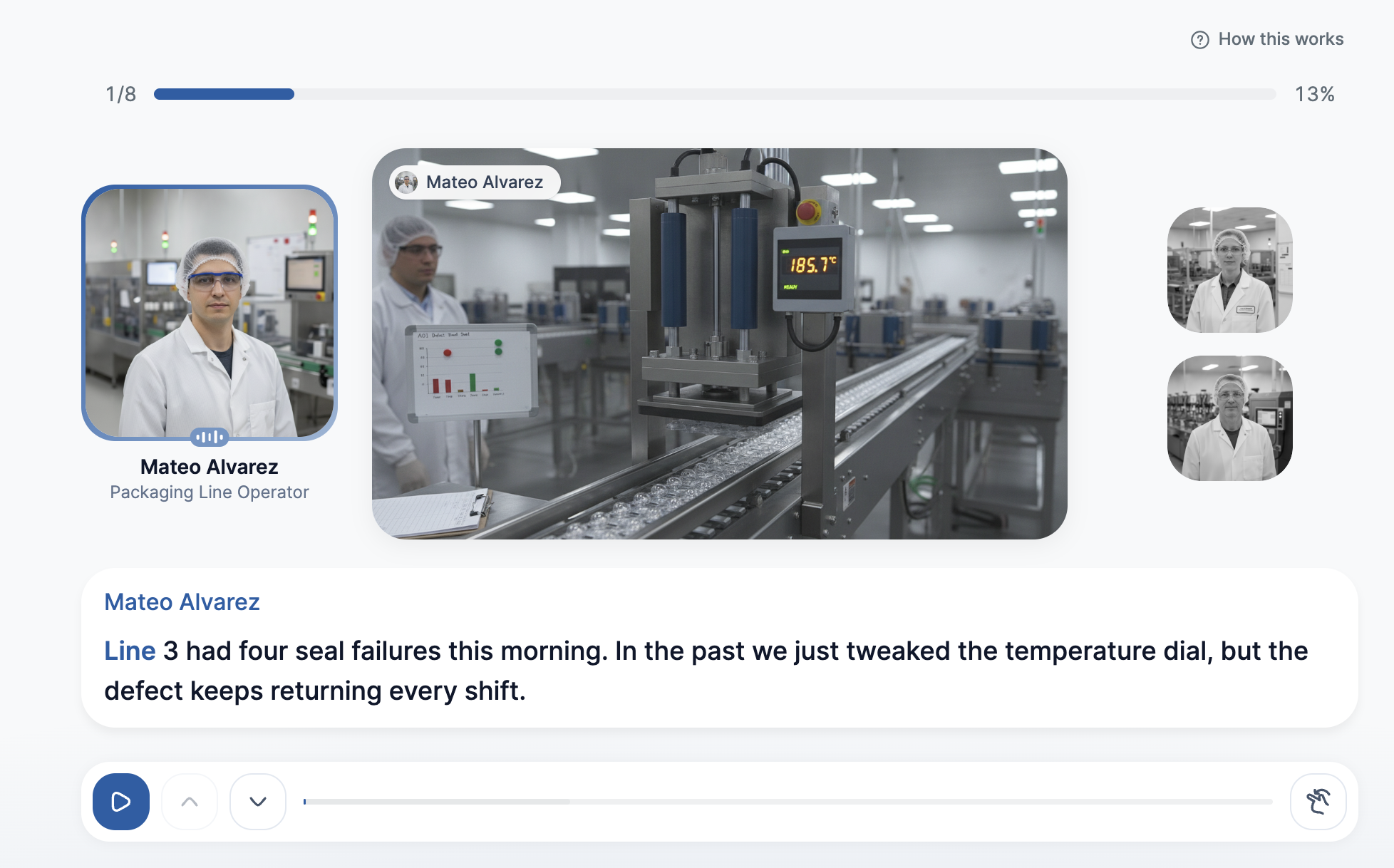
Quiz results, scenario decisions and practical checks feed back into the per-person skill picture. Reassessment, supervisor sign-off and relevant line measures can be compared with the pre-training baseline. And the loop closes outward as well: verified competency is written back to the connected competency platforms and people systems, so records there show the same up-to-date picture of who can do what to standard, without anyone re-keying it. The result should be described as correlated improvement with an explicit level of attribution confidence, not guaranteed causation.
The ranges below are illustrative annual opportunities in the supplied blueprint for a mid-sized facility, not validated savings or a performance guarantee. The pilot is designed to replace assumptions with measured evidence.
Potential annual labor savings from faster SOP and course creation.
Measure: hours per approved itemPotential annual value from shorter unassisted fault resolution.
Measure: resolution time and recoverable hoursPotential annual raw-material savings from consistent setups.
Measure: scrap by line, shift and taskCommercial discipline: Do not simply add these ranges together. A credible ROI must account for overlap, adoption, line economics, implementation effort and Edplay pricing. Net benefit = validated savings and recovered contribution − platform and implementation costs.
Start with two critical lines and a limited group of operators. Agree success measures before launch, then expand only if the results justify it. Pilot counts are proposed targets, not commitments.
Validate available HR, learning, competency and document sources; map a shared skill model for two lines. Identify both skill and missing-knowledge gaps, and record operational baselines.
Invite a proposed 25 operators and technicians to capture recurring fixes, targeting 50 micro-contributions. Route drafts to designated production, quality or maintenance reviewers.
Confirm a learning blueprint, generate targeted scenarios and checks from approved guidance, then compare demonstrated skills and relevant line measures with baseline. Plan later retention checks.
Did connected evidence reveal actionable gaps, did approved knowledge become usable training, and did capability improve alongside agreed plant measures?
Bring operations, quality, L&D and IT together to select pilot lines, confirm available data and agree on the baseline economics.